
The Short Answer
The Golden Thread is a complete, digital record of everything relevant to the safety of a higher-risk building — who did the work, what materials were used, when it was done, and who signed it off. It runs from the first design decision to the day a building is demolished.
For trade contractors — fire stopping installers, passive fire protection firms, gas engineers, electricians, HVAC engineers — the Golden Thread is no longer a concept to be aware of. It is a legal obligation that directly affects your business.
Key Legal Fact
The requirement for a Golden Thread of information is established by the Building Safety Act 2022 and is enforced by the Building Safety Regulator (BSR), a body established within the Health and Safety Executive. Under Section 39 of the Act, failure to comply with building regulations carries a penalty of an unlimited fine and/or up to two years’ imprisonment. Individual directors can also face personal criminal liability where a breach was committed with their consent, connivance or as a result of their neglect.
Where the Golden Thread Came From
On 14 June 2017, a fire at Grenfell Tower in North Kensington killed 72 people. It was the worst residential fire in the UK since the Second World War. In response, the Government commissioned Dame Judith Hackitt to conduct an independent review of building regulations and fire safety. Her final report, Building a Safer Future, published on 17 May 2018, introduced the concept of a “golden thread” — a continuous record that preserves the original design intent of a building and tracks every change made to it.
Dame Hackitt’s review found that poor documentation, weak accountability and disconnected records made it impossible to establish what had been installed, by whom, and whether it met the required standards. The Golden Thread was her answer: a single, trusted source of truth about a building’s safety.
The Government accepted those recommendations in full. They became law through the Building Safety Act 2022, with the key enforcement provisions coming into force on 1 October 2023.
Which Buildings Are In Scope?
The legal requirements apply to higher-risk buildings (HRBs). Under the Building Safety Act, an HRB is defined as a building that is:
- At least 18 meters tall or at least 7 stories high, and
- Contains at least two residential units or is a hospital or a care home
There are currently approximately 12,500 higher-risk buildings in England that fall within scope. All of them are required to be registered with the Building Safety Regulator. Hospitals and care homes meeting the height threshold are included in the regime during design and construction (Part 3 of the Act), but are excluded from the in-occupation regime (Part 4).
While the legal duty applies to HRBs, best practice guidance from the Construction Leadership Council (CLC) increasingly recommends adopting Golden Thread principles across all building safety work, regardless of height.
What the Golden Thread Actually Requires
The Golden Thread is not a specific document or file format. It is a structured approach to managing safety information digitally throughout a building’s life. Under guidance published by GOV.UK and the Health and Safety Executive (HSE), the information must be:
- Digital — it must be stored electronically, not on paper
- Accurate and up to date — it must reflect the building as it actually exists, including any changes made after construction
- Accessible — the right people must be able to access the right information at the right time
- Structured — it must be organized so it can be interrogated by regulators, building managers and residents
What the HSE says the Golden Thread must enable
According to HSE guidance on storing building information, the Golden Thread must allow duty holders to: (1) show that building work meets applicable building regulations; (2) identify, understand and manage building safety risks throughout the building’s life cycle; and (3) support residents and regulators in understanding how the building is kept safe.
What This Means for Trade Contractors Specifically
This is the part most guidance misses. The majority of Golden Thread content is written for principal contractors, developers and building owners. But the records that make up the Golden Thread are, in large part, created by the trade contractors who do the work on site.
As a fire stopping contractor, passive fire engineer, gas engineer or electrical contractor working in or on a higher-risk building, you are responsible for producing verified records that feed into the Golden Thread. That means:
- Job records: documented evidence of every task completed, including the location, scope and method of work
- Material certifications: product certificates, test reports, batch numbers and installation specifications for every safety-critical material used
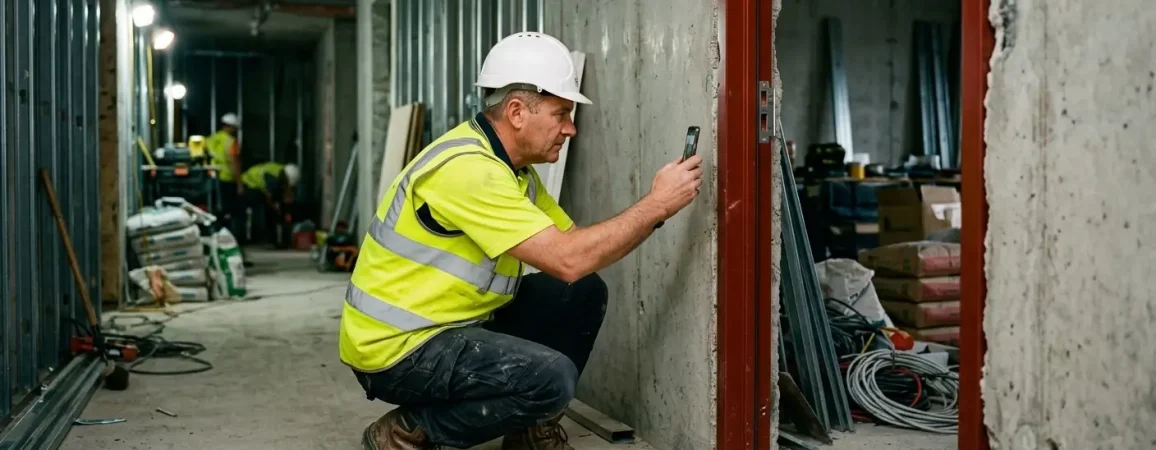
- Photographic evidence: timestamped photographs taken at key stages, including before and after installation
- Competence records: evidence that the person who did the work was qualified to do it (third-party accreditation such as FIRAS, Gas Safe or NICEIC registration)
- Sign-off: a clear record of who approved the work, when, and on what basis
Principal contractors are increasingly mandating that subcontractors deliver this information in a structured, digital format before work is accepted. If you cannot provide it, you risk losing contracts.
The “Right People, Right Information, Right Time” Principle
GOV.UK guidance describes the Golden Thread using a principle of three “rights”: the right people must have the right information at the right time. In practice, this means:
- A BSR inspector arriving on site should be able to verify the work you did within minutes, not days
- A building manager dealing with a fire door issue should be able to trace exactly who installed it, which product was used, and whether it met the specification
- If your firm hands a project over to a different contractor, all documentation must transfer with it, intact and usable
Scattered records — photos on a phone, certificates in email threads, job notes on paper — do not meet this standard. When an audit arrives, piecing together scattered evidence takes days and often leaves dangerous gaps.
KEY TAKEAWAYS FOR TRADE CONTRACTORS
- The Golden Thread is a legal requirement for work on higher-risk buildings under the Building Safety Act 2022
- It requires digital, accurate, structured and accessible records — not paper or scattered files
- Trade contractors produce the records that form a large part of the Golden Thread
- Non-compliance carries an unlimited fine and/or up to two years’ imprisonment; individual directors can face personal criminal liability
Ready to see how Golden Fred handles this in practice?
Golden Fred is a compliance and operational management platform built specifically for fire safety and building safety contractors. It combines job management, Golden Thread documentation and AI compliance guidance in one place — so your records are audit-ready by default, not assembled in a panic before an inspection.
Every job your engineers complete automatically builds a structured compliance record. Certifications, photos, sign-offs and change logs — all linked, all searchable, all ready when the BSR asks.