
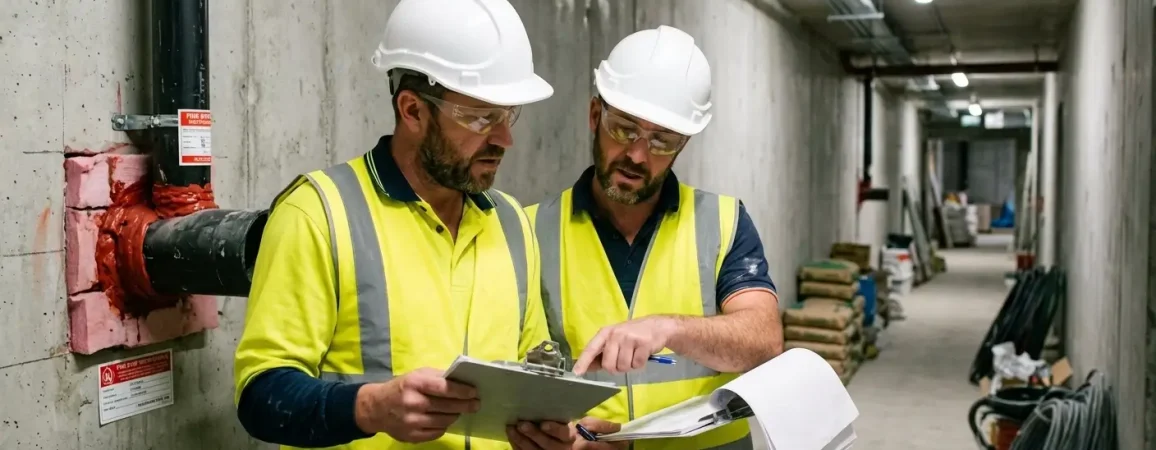
BSR Inspections Are Happening Now
The Building Safety Regulator (BSR) — established within the Health and Safety Executive under the Building Safety Act 2022 — is now fully operational and actively inspecting higher-risk buildings and construction projects across England.
For contractors working on or within higher-risk buildings (HRBs), the question is no longer whether an inspection will happen. It is whether your records will hold up when it does.
What is a higher-risk building?
Under the Building Safety Act 2022, a higher-risk building is any residential building that is at least 18 metres tall or at least 7 storeys, with two or more residential units. Hospitals and care homes meeting the same height threshold are included in the regime during design and construction (Part 3 of the Act), but are excluded from the in-occupation regime (Part 4). The 12,500 figure refers to occupied residential HRBs in England required to be registered with the BSR.
Understanding the Three Gateway System
For new construction and major refurbishment of higher-risk buildings, the BSR operates a three-gateway regime. Each gateway is a hold point — work cannot proceed to the next stage without BSR approval.
| Gateway | When It Applies | What the BSR Checks | Who It Affects |
| Gateway 1 | Planning application stage | Fire safety considerations in the planning permission | Client, principal designer |
| Gateway 2 | Before construction begins | Building regulations approval — design documentation, plans, fire strategy. A hard stop: work cannot begin without BSR approval | Principal designer, principal contractor |
| Gateway 3 | Before occupation | Completion certificate — as-built evidence, Golden Thread handover and compliance | Principal contractor, all trade contractors |
For trade contractors, Gateway 3 is the most immediately relevant. The BSR must issue a completion certificate before any new residential unit in a higher-risk building can be occupied. That certificate requires documented evidence of all work completed — and your records are part of that evidence.
What BSR Inspectors Look For
The BSR uses multi-disciplinary inspection teams (MDTs), which typically include fire engineers, building control professionals and fire service representatives. During site inspections, these teams assess:
- Whether the work being done matches the approved design
- Whether changes to the approved design have been formally logged and approved
- Whether a Construction Control Plan is in place and being maintained
- Whether competence requirements have been met — the right people, with the right qualifications, did the right work
- Whether the Golden Thread is being maintained and will be ready for handover
Criminal liability for directors
Under the Building Safety Act 2022, non-compliance with Golden Thread requirements and building regulations on higher-risk buildings is not just a financial risk. Directors and senior managers can face personal criminal liability. Under Section 39 of the Act, the penalty for breaching building regulations is an unlimited fine and/or up to two years’ imprisonment. Under Section 40, individual directors can be prosecuted where a breach was committed with their consent, connivance or as a result of their neglect.
Practical Pre-Inspection Checklist for Contractors
-
Job Records and Work Evidence
- Every job logged with a unique reference — project, building, floor/zone, task type
- Date and time of work recorded, not estimated
- Name and employer of the person who carried out the work
- Description of scope — what was done, what was not done and why
- Photographic evidence — timestamped, geotagged where possible — taken before, during and after installation
-
Material and Product Records
- Product name, manufacturer and model/specification for every safety-critical material used
- Batch numbers and product certificates — third-party tested and certified products only
- Test reports and classification evidence (e.g. fire rating certificates, CE/UKCA marks)
- If a substitution was made, a formal record of why and confirmation the substitute meets the same specification
-
Competence and Accreditation Records
- Third-party accreditation certificates for the firm — FIRAS, BAFE, Gas Safe, NICEIC, CHAS or equivalent
- Individual operative competence records — qualifications, training, scheme membership
- Evidence that site-specific inductions were completed, particularly on fire safety and firestopping
-
Sign-off and Approval Records
- Clear record of who approved the completed work — name, role, date
- Any non-conformances noted and the action taken to resolve them
- Handover confirmation if the work was reviewed by a principal contractor or client representative
-
Change Control
- A log of any changes made to the original scope or specification during the project
- Evidence that changes were formally reviewed and approved before being implemented
- Any changes affecting fire safety must be reviewed for compliance with Building Regulations Part B before proceeding
What the law says about change control
Under The Building (Higher-Risk Buildings Procedures) (England) Regulations 2023, the principal contractor is responsible for maintaining a change control log. This log must include evidence that changes have been assessed for compliance with applicable building regulations before being carried out. Sub-contractors must provide documented evidence of any changes they make to their scope of work.
The Most Common Documentation Failures
- Photos without timestamps or location information — making it impossible to verify when and where work was done
- Missing product certificates — a job record exists but the material certification is in someone’s email inbox or was never collected
- Informal substitutions — a product was swapped on site without a formal record, because the original was unavailable
- Gaps in competence records — work was carried out by an operative whose individual qualifications were not documented
- Fragmented records across multiple systems — jobs in one system, documents in another, photos on a personal phone
How to Make Your Records Audit-Ready by Default
The contractors who pass BSR inspections without scrambling are not those who prepared harder in the week before an inspection. They are the ones who structured their operations so that every job automatically produces a compliant record.
That means treating documentation not as an afterthought but as a product of the work itself. Every job creates the evidence. Every material logged at the time of installation. Every sign-off captured digitally before leaving site.
When that structure is in place, preparing for a BSR inspection takes hours, not days.
PRE-INSPECTION CHECKLIST: QUICK REFERENCE
- Job records with dates, names and scopes for every task
- Timestamped photographic evidence for every installation
- Product certificates and batch numbers for all safety-critical materials
- Accreditation and competence records for all operatives
- Signed sign-off records and non-conformance logs
- Formal change control log for any scope or specification changes
Ready to see how Golden Fred handles this in practice?
Golden Fred is a compliance and operational management platform built specifically for fire safety and building safety contractors. It combines job management, Golden Thread documentation and AI compliance guidance in one place — so your records are audit-ready by default, not assembled in a panic before an inspection.
Every job your engineers complete automatically builds a structured compliance record. Certifications, photos, sign-offs and change logs — all linked, all searchable, all ready when the BSR asks.