
The Documentation Problem Most Contractors Have
Ask a fire safety contractor what happened on a job six months ago and the answer usually involves opening several different systems: a job management app, an email inbox, a shared drive, possibly a WhatsApp group. Somewhere in that collection is the information needed to prove compliance. But finding it takes time — and assembling it into something an auditor can review takes even longer.
Under the Building Safety Act 2022, that approach is not just inefficient. It is a compliance risk. The Golden Thread requirement means that documentation must be structured, digital, accessible and accurate — not scattered across systems that do not talk to each other.
What the Law Requires Contractors to Document
The specific documentation requirements for contractors on higher-risk buildings are set out across several pieces of secondary legislation:
- The Building (Higher-Risk Buildings Procedures) (England) Regulations 2023
- The Higher-Risk Buildings (Management of Safety Risks) Regulations 2023
- The Building Regulations etc. (Amendment) (England) Regulations 2023
-
Work Records
A record of every task carried out, including: the date and time of work, the location within the building (floor, zone or specific element), the scope of work completed, any work that was deferred or left incomplete and the reason, and the name and competence credentials of the operative who carried it out.
-
Material and Product Records
For every safety-critical material installed — fire stopping products, fire doors, passive fire protection components — contractors must record:
- Product name, manufacturer and full specification
- Batch numbers and date of installation
- Third-party test certificates and certification numbers
- Evidence that the product was installed in accordance with the manufacturer’s instructions and the relevant British Standard
Why Product Certificates Matter
If a fire door or fire stopping product is installed without a product certificate, there is no way to verify whether it meets the required fire resistance rating. In the event of a fire, or a post-incident investigation, this gap in the Golden Thread creates both a safety risk and a legal exposure for the contractor who installed it.
-
Photographic and Visual Evidence
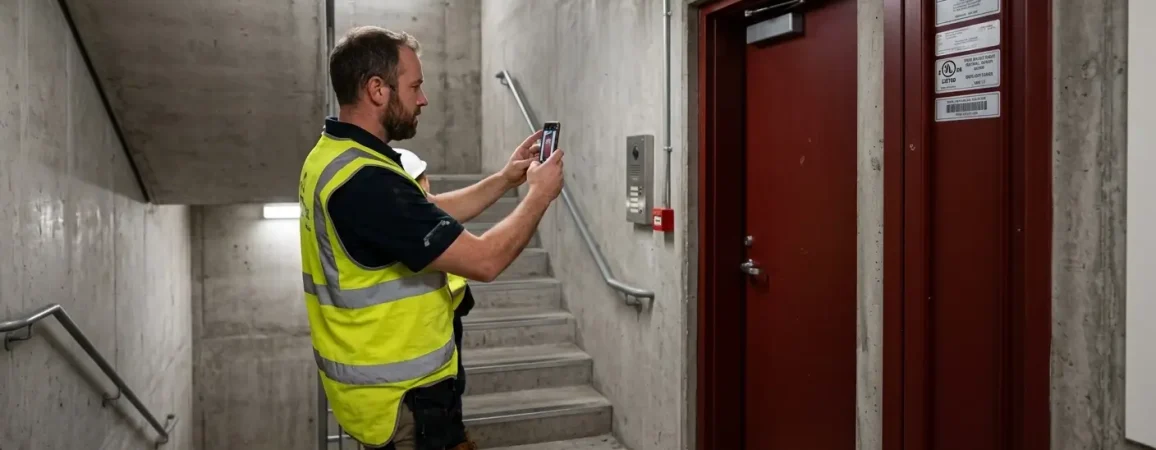
Photographs must be timestamped, location-tagged or linked to a specific job record, and taken at key stages: before work begins, during installation (especially for concealed elements such as cavity barriers and firestopping around penetrations) and after completion.
For passive fire protection work, photographs are particularly critical. Once a ceiling is closed or a wall is finished, there is no way to verify what was installed inside without opening it back up. Photographs taken before elements are concealed are the only way to prove compliance after the fact.
-
Competence Records
Under the Building Safety Act, competence is a legal requirement. Competence records should include:
- Current third-party scheme membership certificates — FIRAS, BAFE, Gas Safe, NICEIC, CHAS or equivalent
- Individual training records and qualifications for operatives
- Evidence that competence was assessed before operatives were deployed on a specific higher-risk building
-
Sign-off and Approval Records
Every piece of work must have a clear sign-off record — who approved the work as complete, in what capacity, and on what date. Any snagging, remediation or non-conformances noted must also be recorded, along with the outcome.
-
Change Control Records
If anything changes from the approved scope or specification during the project, that change must be formally logged. The log must record what changed, why, who approved the change, and whether the change was assessed for compliance with applicable building regulations before being implemented.
The Format Problem: Why Scattered Records Fail the Standard
- Photos on personal phones are not accessible to regulators or principal contractors and are at risk of deletion if a device is lost or an employee leaves
- Certificates in email inboxes cannot be searched by project, building or element and are not linked to the job records they relate to
- Job notes on paper are not digital, not searchable and cannot be handed over in the structured format required at Gateway 3
- Spreadsheets provide no automatic link between a job record and its associated documentation and cannot be assembled into audit-ready evidence quickly
What the CLC says about digital storage
The Construction Leadership Council’s golden thread guidance states that information must be stored in an electronic format with version control, established by the client at the outset of a project. It must be maintained to reflect any changes within the building. The format must allow information to be transferred between parties as responsibility passes between project stages.
Making Compliance a By-Product of Normal Work
The contractors who manage this most effectively are not those who add documentation as an extra task at the end of each day. They are the ones who have structured their operations so that documentation happens automatically as a by-product of doing the work.
When a job is raised in the system, the record exists. When a photo is taken on site, it is tagged to the job. When a material is installed, the certificate is attached. When the work is signed off, the approval is logged. When the audit arrives, everything is already there.
That is what audit-ready by default means in practice. It is not a documentation sprint before an inspection. It is a way of working that generates compliance evidence as a natural output of operational activity.
MINIMUM DOCUMENTATION STANDARD FOR CONTRACTORS ON HIGHER-RISK BUILDINGS
- Work records: dates, locations, scopes, operative names
- Material records: product certificates, batch numbers, specifications
- Photographic evidence: timestamped, linked to job records
- Competence records: scheme accreditation and individual qualifications
- Sign-off records: who approved what, when, and the outcome
- Change control log: all deviations from approved scope, with approvals
- Format: digital, structured, accessible and transferable — not paper or disconnected files
Ready to see how Golden Fred handles this in practice?
Golden Fred is a compliance and operational management platform built specifically for fire safety and building safety contractors. It combines job management, Golden Thread documentation and AI compliance guidance in one place — so your records are audit-ready by default, not assembled in a panic before an inspection.
Every job your engineers complete automatically builds a structured compliance record. Certifications, photos, sign-offs and change logs — all linked, all searchable, all ready when the BSR asks.